


Swami Vivekananda is one of the most influential spiritual figures of the modern era — a monk who combined the ancient wisdom of Vedanta with a strikingly modern, rational, and practical outlook on life. He is best remembered for his historic address at the World’s Parliament of Religions in Chicago in 1893, but his contribution goes far beyond one famous speech. He reshaped how India saw itself, how the West saw Hindu philosophy, and how spirituality could be tied directly to social service and national regeneration.
This detailed guide covers Swami Vivekananda’s early life, his relationship with his guru Ramakrishna Paramahamsa, his years as a wandering monk, his transformative journey to America, his core philosophy, his most memorable quotes, and the books he authored.
Early Life of Swami Vivekananda
Birth and Family Background
Swami Vivekananda was born Narendranath Datta on January 12, 1863, in Calcutta, in a well-established Bengali Kayastha family. His father, Vishwanath Datta, was a successful attorney at the Calcutta High Court — a rational, broad-minded man fluent in Persian and English, known for his progressive views. His mother, Bhuvaneswari Devi, was a devout and disciplined woman whose religious faith and strong character deeply shaped Narendra’s early personality. Narendra later credited his mother’s influence heavily, once remarking that whatever he had achieved in life, he owed to her.
Narendra was one of nine children, though several siblings died young, which was common in that era. From an early age, he displayed an exceptional memory, a restless, questioning mind, and a fondness for meditation — family members recalled him meditating before an image of Shiva as a child, sometimes so deeply absorbed that he lost awareness of his surroundings.
Education and Intellectual Formation
Narendra was academically brilliant. He studied at the Metropolitan Institution before enrolling at Presidency College and later graduating from General Assembly’s Institution (now Scottish Church College), Calcutta, where he studied Western logic, European history, and philosophy.
He read voraciously — from the works of David Hume, Immanuel Kant, Johann Fichte, Baruch Spinoza, Georg Hegel, Arthur Schopenhauer, Auguste Comte, and Herbert Spencer, to the classical Sanskrit scriptures of India. This rare combination of rigorous Western rational training and deep familiarity with Indian scripture gave him an unusually broad intellectual toolkit — one he would later use to present Vedanta to Western audiences in language they could understand and respect.
The Spiritual Crisis
Despite his brilliance, Narendra went through a period of deep skepticism and spiritual restlessness during his college years. He briefly associated with the Brahmo Samaj, a reformist Hindu movement led by figures like Keshab Chandra Sen, drawn to its rejection of idol worship and its emphasis on monotheism and rational faith. Yet even within the Brahmo Samaj, he found no one who could satisfy his deepest question — one he began putting to every religious figure and teacher he met:
“Have you seen God?”
Most gave evasive or unconvincing answers. This unresolved yearning eventually led him to a mystic living at the Dakshineswar Kali Temple — Sri Ramakrishna Paramahamsa.
Meeting His Guru: Sri Ramakrishna Paramahamsa

The First Meeting
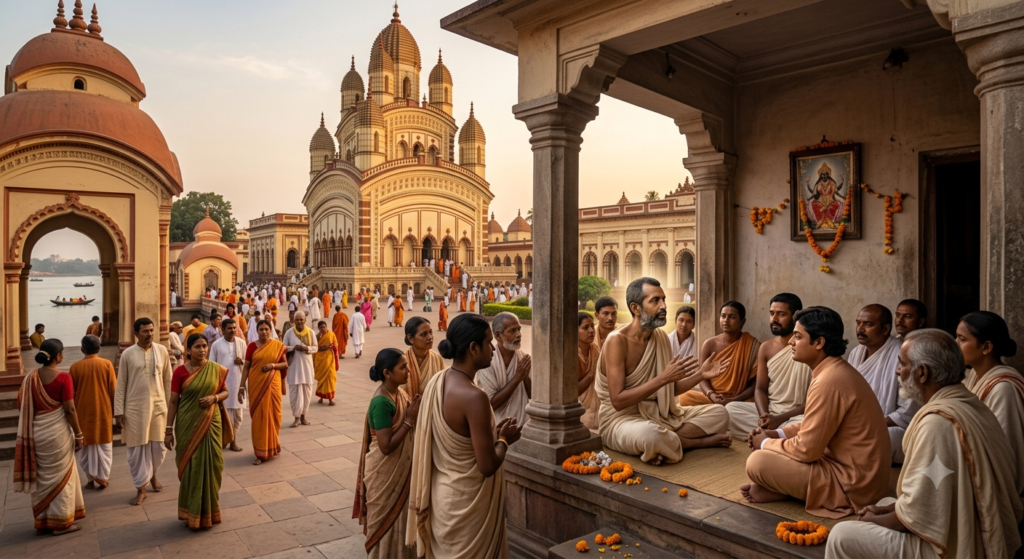
Narendra first met Ramakrishna in 1881, when a professor at his college, William Hastie, mentioned that he had seen a man in a trance-like spiritual state only at Dakshineswar. Narendra visited out of curiosity, and, as he had with others, bluntly asked Ramakrishna if he had seen God.
Ramakrishna answered without a moment’s hesitation: yes, he had seen God, as clearly and directly as he was seeing Narendra in front of him — and more clearly still. This response staggered Narendra. Unlike every other teacher he had approached, Ramakrishna spoke from direct experience rather than doctrine or scripture.
Testing the Guru
True to his rational, skeptical nature, Narendra did not accept Ramakrishna’s authority immediately. Over the following years, he questioned him relentlessly, resisted his teachings, argued against ritualistic worship, and even doubted Ramakrishna’s visions as possible hallucinations. Ramakrishna, remarkably, welcomed this skepticism rather than being offended by it — he considered Narendra’s rational questioning a sign of a truly enquiring mind, and reportedly said he would never accept anything Narendra could not verify for himself.
Gradually, through personal experiences — including a touch from Ramakrishna that Narendra said induced a profound altered state of consciousness — Narendra’s doubts dissolved into devotion. He became one of Ramakrishna’s closest and most trusted disciples.
Ramakrishna’s Final Years
By 1885, Ramakrishna was diagnosed with throat cancer. He was moved to a garden house in Cossipore, where his young disciples, including Narendra, nursed him around the clock while continuing their spiritual training under him. It was here that Ramakrishna is said to have transferred his spiritual powers to Narendra shortly before his death, telling him he would have to guide the other disciples and carry forward the mission.
Ramakrishna passed away on August 16, 1886.
Formation of the Monastic Order
After their guru’s death, the grief-stricken young disciples, largely unsupported financially, rented a dilapidated house at Baranagar near Calcutta and formed a monastic brotherhood, taking formal vows of asceticism. This was the seed of what would eventually become the Ramakrishna Math. It was during this period that Narendra began using different monastic names during his travels, eventually settling on the name by which the world would come to know him — Swami Vivekananda.
The Wandering Monk Years (1888–1893)
Between 1888 and 1893, Vivekananda left the Baranagar monastery to travel across India on foot and by train as a parivrajaka, or wandering monk, carrying only a staff, a water pot, and a few religious texts, depending entirely on alms.
Journey Across India
He traveled through the length and breadth of the subcontinent — from the Himalayas to Kanyakumari — staying in Varanasi, Ayodhya, Lucknow, Agra, Vrindavan, Alwar, Jaipur, Khetri, Ahmedabad, Junagadh, Porbandar, Bombay, Belgaum, Mysore, Trivandrum, Madras, and finally Kanyakumari, the southernmost tip of India. Along the way, he met maharajas, scholars, and ordinary villagers alike, moving freely between palaces and the poorest huts.
This period was transformative. Vivekananda witnessed firsthand the crushing poverty of ordinary Indians, rigid caste discrimination, and the widening gap between India’s spiritual heritage and its material condition under colonial rule. He grew convinced that no genuine spirituality could exist alongside indifference to human suffering — a conviction that later defined the entire mission of the Ramakrishna Order.
The Vision at Kanyakumari
In December 1892, Vivekananda swam out to a rock formation off the coast at Kanyakumari, where India’s three seas meet, and meditated for three days. It was here, according to tradition, that he had a profound vision of India’s spiritual destiny and his own role in awakening both India and the world. This experience is widely credited as the turning point that convinced him to travel to America and represent Hinduism at the upcoming World’s Parliament of Religions. The Vivekananda Rock Memorial, built in 1970, now stands at this site as a major pilgrimage destination.
The Maharaja of Khetri
Among the many patrons Vivekananda met during his travels was Ajit Singh, the Maharaja of Khetri, who became a devoted admirer and financial supporter. It was Ajit Singh who suggested the name “Vivekananda” — combining “viveka” (discernment) and “ananda” (bliss) — and who helped fund his voyage to America.
Swami Vivekananda’s Journey and Speech in America (1893)
The Voyage
Vivekananda set sail from Bombay on May 31, 1893, traveling via Colombo, Penang, Singapore, Hong Kong, and Yokohama before crossing the Pacific to Vancouver and then Chicago. He arrived in Chicago without formal credentials, a fixed contact, or even confirmation that the Parliament’s registration was still open — and to complicate matters, he discovered he had lost the address of the only contact he had in the city.
For a difficult stretch, running low on funds in an unfamiliar country, he reportedly spent a night sleeping in an empty freight car and, by his own account, went hungry begging door to door in Chicago before a kind woman, Mrs. George W. Hale, took him in and helped connect him with the organizers of the Parliament.
Securing a Place at the Parliament
A chance meeting on a train with Professor John Henry Wright of Harvard University proved decisive. Impressed by Vivekananda’s knowledge and eloquence, Wright wrote a letter of introduction to the Parliament’s selection committee, reportedly stating that asking a man like Vivekananda for his credentials was “like asking the sun to state its right to shine.” This letter secured Vivekananda a place among the official delegates.
The Historic Speech — September 11, 1893
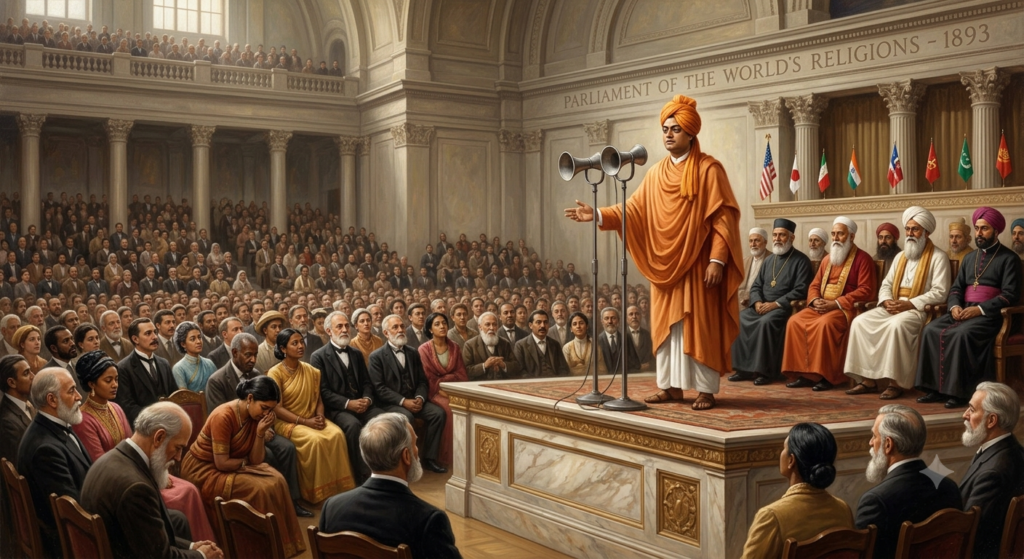
The World’s Parliament of Religions opened in Chicago on September 11, 1893, as part of the World’s Columbian Exposition. When Vivekananda’s turn came to speak, he was reportedly nervous, having never addressed such a vast, formal gathering. He began with a simple, unscripted greeting that broke sharply from the stiff, formal openings used by every other speaker that day:
“Sisters and Brothers of America…”
This warm, direct address reportedly moved the audience of roughly seven thousand people to a standing ovation lasting several minutes — before he had even delivered the substance of his speech. In the address that followed, he spoke about universal religious tolerance, quoting from Hindu scripture to argue that all paths of faith ultimately lead to the same truth, and he sharply criticized religious bigotry and sectarianism, famously declaring pride in belonging to a religion that had taught the world both tolerance and universal acceptance of all faiths as true.
Over the following two weeks of the Parliament, he delivered several more addresses, each reportedly well received, cementing his reputation as one of the most compelling voices at the gathering. American newspapers described him as strikingly eloquent and among the standout figures of the Parliament.
The Lecture Tour and Life in the West
Vivekananda’s success at the Parliament opened doors across America. For the next three years, he toured extensively, lecturing in Chicago, Detroit, Boston, New York, and dozens of other cities on Vedanta philosophy, yoga, and Hindu thought, while also facing organized opposition from Christian missionary groups uncomfortable with his popularity.
During this period, he:
- Founded the Vedanta Society of New York in 1894, the first Vedanta organization in the West.
- Formed close, lasting friendships with prominent Americans, including Josephine MacLeod and the Hale family, who became lifelong supporters.
- Met and influenced Margaret Elizabeth Noble, an Irish woman who later became his disciple, took the name Sister Nivedita, and moved to India to dedicate her life to social work and women’s education.
- Traveled to England and other parts of Europe, lecturing on Vedanta in London and Paris.
- Reportedly met inventor Nikola Tesla, discussing the parallels between Vedantic cosmology and modern physics — an exchange later cited as an early example of dialogue between Eastern philosophy and Western science.
He returned to India in January 1897, arriving to a hero’s welcome, now recognized not just as a monk but as a figure who had carried India’s spiritual voice onto the world stage.
Founding the Ramakrishna Mission and Belur Math

The Ramakrishna Mission
On May 1, 1897, Vivekananda formally established the Ramakrishna Mission in Calcutta, named in honor of his guru. Unlike many purely contemplative monastic orders, the Mission was built on a dual foundation: spiritual practice combined with active, organized service to humanity — summarized in his teaching that service to man is service to God (Shiva Jnane Jiva Seva).
Under this philosophy, the Mission rapidly established:
- Schools and colleges across India
- Hospitals, dispensaries, and mobile medical units
- Famine and flood relief operations
- Rural development and vocational training programs
The Ramakrishna Mission remains one of India’s most respected socio-religious and humanitarian organizations more than a century later.
Belur Math
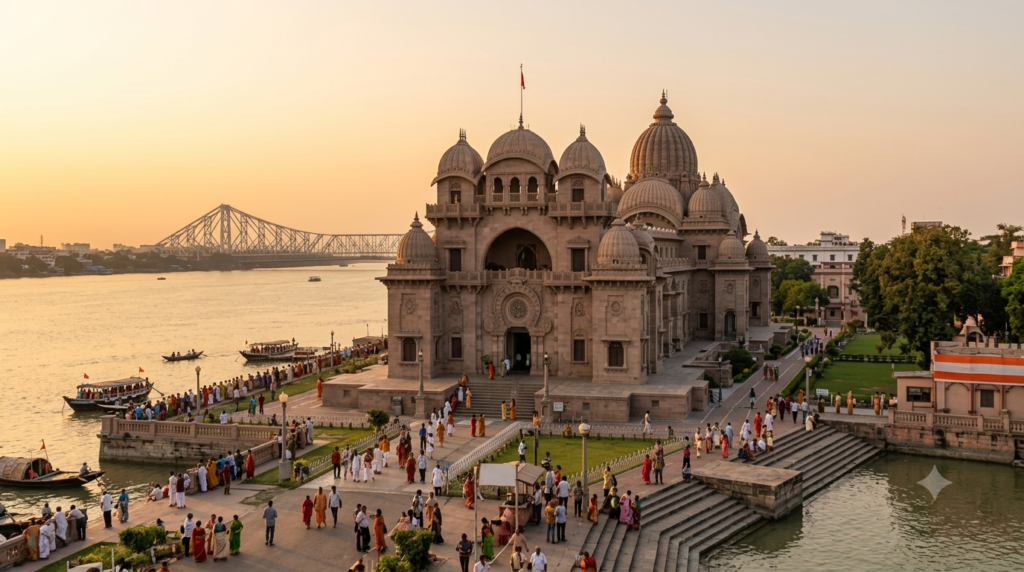
In 1899, Vivekananda consecrated Belur Math, on the western bank of the Hooghly River near Calcutta, as the permanent headquarters of the Ramakrishna Order. Its architecture deliberately blends Hindu, Christian, and Islamic design elements — a physical embodiment of his belief in the underlying unity of all religions.
Second Visit to the West (1899–1900)
Vivekananda undertook a second trip to the West in 1899, visiting America and England again, further strengthening the Vedanta Society network and delivering more lectures, before returning to India in 1900 in declining health.
Advaita Ashrama, Mayavati
In 1899, on the advice of Western disciples, the Ramakrishna Order also established the Advaita Ashrama at Mayavati in the Himalayas, dedicated to the propagation of Advaita Vedanta philosophy through publishing and contemplative practice — an institution that continues to publish Vivekananda’s collected works today.
Core Teachings and Philosophy of Swami Vivekananda
Practical Vedanta
Vivekananda is often credited with popularizing what scholars call “Practical Vedanta” or Neo-Vedanta — taking the abstract, monistic philosophy of Advaita Vedanta (the idea that the individual soul, or Atman, is identical to the universal reality, or Brahman) and translating it into a practical guide for everyday living, self-confidence, and social action, rather than leaving it as a purely monastic or scholarly pursuit.
The Four Yogas
Vivekananda structured much of his teaching around what he described as four complementary paths to spiritual realization, each suited to different temperaments:
- Karma Yoga — the path of selfless action, performing one’s duty without attachment to results.
- Bhakti Yoga — the path of devotion and love directed toward the divine.
- Jnana Yoga — the path of knowledge, intellectual inquiry, and discrimination between the real and unreal.
- Raja Yoga — the path of meditation and mental discipline, drawing heavily on Patanjali’s classical yoga philosophy.
He taught that these paths were not mutually exclusive, and that a well-rounded spiritual life could draw on all four.
Strength as a Spiritual Value
A recurring theme in Vivekananda’s teaching was the rejection of weakness — physical, mental, or spiritual — as incompatible with genuine religion. He urged people, especially young Indians, to build physical vigor and self-confidence alongside spiritual practice, famously telling audiences that they would be nearer to God through football than through the Bhagavad Gita if it made them stronger and braver.
Unity of Religions
Central to his message was the conviction that all religions are valid paths toward the same ultimate truth, and that the goal should not be mere tolerance — which implies a grudging acceptance of something considered wrong — but genuine acceptance of the validity of every sincere path.
Service as Worship
Vivekananda’s concept of “Daridra Narayana” — seeing God in the poor and suffering — reframed social service as a direct form of spiritual practice rather than mere charity, a philosophy that continues to guide the Ramakrishna Mission’s humanitarian work today.
Education and the Idea of Man-Making
Vivekananda was a fierce critic of rote-learning education that merely transferred information. He argued that true education should draw out the perfection already inherent within a person, building character, self-reliance, and courage — an idea he called “man-making and character-building education.” He was also a vocal advocate for women’s education and empowerment, and for eliminating caste-based restrictions on knowledge and opportunity.
Nationalism and Indian Identity
Vivekananda is regarded as one of the intellectual precursors of Indian nationalism. He argued that India’s future lay in combining its spiritual heritage with Western scientific and material progress, and he inspired a generation of freedom fighters and reformers, including Subhas Chandra Bose, Sri Aurobindo, and, indirectly, Mahatma Gandhi, all of whom acknowledged his influence on their thinking.
Famous Quotes by Swami Vivekananda
On Strength and Courage
- “Arise, awake, and stop not till the goal is reached.”
- “Strength is life, weakness is death.”
- “The world is the great gymnasium where we come to make ourselves strong.”
On Self-Belief
- “You cannot believe in God until you believe in yourself.”
- “All the powers in the universe are already ours. It is we who have put our hands before our eyes and cry that it is dark.”
- “Stand up, be bold, be strong. Take the whole responsibility on your own shoulders.”
On Purpose and Focus
- “Take up one idea. Make that one idea your life — think of it, dream of it, live on that idea.”
- “In a day, when you don’t come across any problem — you can be sure that you are travelling in a wrong path.”
On Truth and Religion
- “Comfort is no test of truth. Truth is often far from being comfortable.”
- “Each soul is potentially divine. The goal is to manifest this divinity within.”
- “Truth can be stated in a thousand different ways, yet each one can be true.”
On Education and Growth
- “We want that education by which character is formed, strength of mind is increased, the intellect is expanded, and by which one can stand on one’s own feet.”
Books Written by Swami Vivekananda
Many of Swami Vivekananda’s works were compiled from his lectures, letters, and conversations, later organized into books by his disciples and the Advaita Ashrama publishing house.
| Book | Focus Area |
|---|---|
| Raja Yoga | A detailed exposition of meditation, mind control, and Patanjali’s yoga philosophy; one of the first serious Western introductions to yoga as a science of the mind |
| Karma Yoga | The philosophy of selfless action, duty, and work without attachment to results |
| Bhakti Yoga | The path of devotion, love, and surrender toward the divine |
| Jnana Yoga | The path of knowledge and the philosophy of Advaita Vedanta |
| Lectures from Colombo to Almora | A compilation of speeches delivered across India after his triumphant return from the West |
| My Master | A personal, reverent account of his guru, Sri Ramakrishna Paramahamsa |
| Inspired Talks | Informal conversations and teachings recorded by his close students in America |
| The East and the West | Comparative reflections on Indian and Western civilizations, values, and social structures |
| Vedanta Philosophy | Lectures explaining the core tenets of Vedantic thought to Western audiences |
| Complete Works of Swami Vivekananda | A comprehensive, multi-volume collection of his lectures, essays, poems, and letters, published by Advaita Ashrama |
Death and Legacy
Swami Vivekananda passed away on July 4, 1902, at Belur Math, at the young age of 39. According to those close to him, he had spoken of not expecting to live past forty. Despite the brevity of his life, his intellectual and spiritual legacy has proven remarkably enduring.
National Youth Day
In recognition of his role in inspiring young people toward self-confidence, service, and national pride, the Government of India declared his birthday, January 12, as National Youth Day, observed annually with speeches, cultural events, and educational programs across the country.
Lasting Influence
Vivekananda’s influence extends across religion, education, and Indian nationalism. His emphasis on self-respect, unity among faiths, and social service continues to shape the work of the Ramakrishna Mission, which today operates hundreds of schools, hospitals, and relief centers across India and abroad. His Chicago address remains one of the most frequently cited moments in the modern history of interfaith dialogue.
Conclusion
Swami Vivekananda’s life journey — from a questioning young student in Calcutta to a wandering monk across India, to the man who addressed thousands in Chicago and reshaped global perceptions of Indian philosophy — remains one of the most compelling stories of spiritual transformation combined with real-world impact. His teachings on inner strength, religious harmony, and selfless service continue to resonate more than a century after his passing, offering guidance that feels as relevant to modern readers as it did to the audiences who first heard him speak.