


From His Early Years to His Path of Devotion and Service
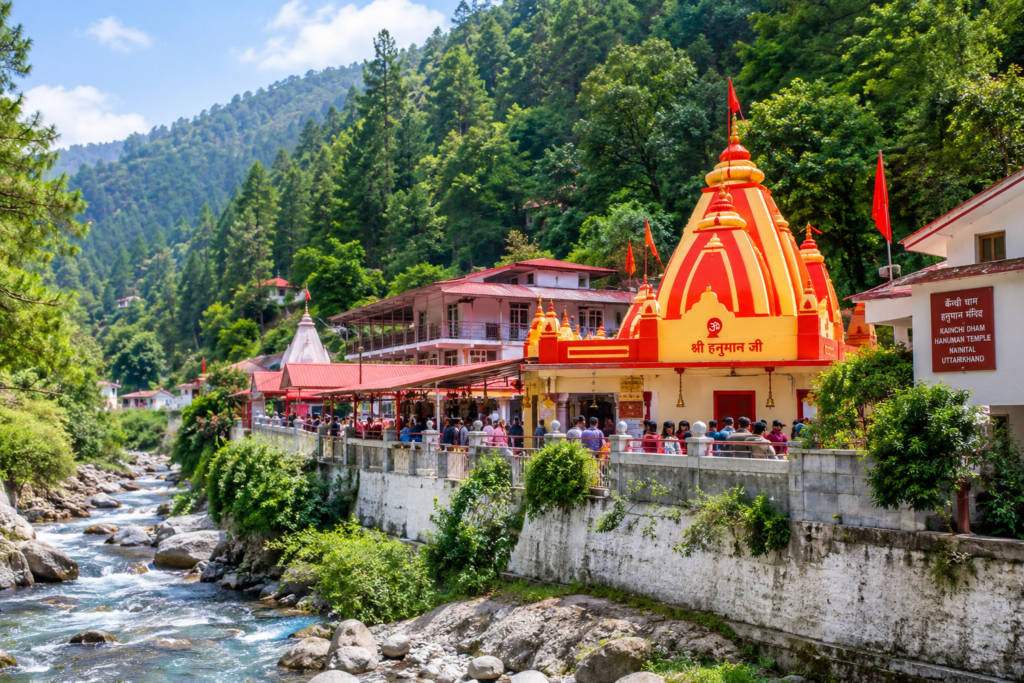
On the Nainital–Almora road, two sharp hairpin bends lead into a wooded valley beside a mountain stream. This is Kainchi Dham, one of the most visited spiritual places in India. It is a Hanuman temple and ashram built by a saint who owned almost nothing and fed everyone who arrived.
That saint was Neeb Karori Baba, better known online as Neem Karoli Baba. The two spellings refer to the same man. His followers call him Maharaj-ji. “Neeb Karori” comes from a village where he spent part of his wandering years, and “Neem Karoli” is the version that spread in English.
Interest in him has surged in 2026. Two Hindi films about his life have released this year: Shree Baba Neeb Karori Maharaj on 29 May and Hanuman Ansh on 7 August. This article covers who he was, what Kainchi Dham is, where his other ashrams are, and which well-known people are connected to him, separating documented facts from devotional tradition.

Quick Facts
| Born | c. 1900, Akbarpur, Uttar Pradesh, as Lakshman Narayan Sharma (sources differ on the district) |
| Also known as | Neeb Karori Baba, Neem Karoli Baba, Maharaj-ji |
| Died | 11 September 1973, near Mathura–Vrindavan |
| Main ashram | Kainchi Dham, Nainital district, Uttarakhand |
| Temple inaugurated | 15 June 1964 |
| Deity | Hanuman |
| Annual gathering | Kainchi Dham Mela, 15 June |
| Location | 17 km from Nainital, 9 km from Bhowali, roughly 35–40 km from Kathgodam |
Who Was Neeb Karori Baba?
Early life
He was born around 1900 into a wealthy Brahmin family in Akbarpur, Uttar Pradesh. The exact date is unknown because records from his early years are thin. His parents married him at eleven. Around 1911 he left home and wandered northern India as a sadhu known as Baba Lakshman Das.
Years later he returned at his father’s request and lived as a householder. He had two sons and a daughter. He was a family man before he became a saint, and he never fit the image of a monk who cut all ties.
The name
His father was once told that a sadhu resembling his son was living in a village called Neeb Karori in Uttar Pradesh. The village gave him his name. A popular devotee story adds that a train refused to move after he was put off at the local station. It is told with great affection, but it is tradition, not documented history.
A life between plains and hills
He did not stay in one place. From July 1958 he spent his winters with Professor Sudhir “Dada” Mukerjee and his wife in Allahabad, and this continued until his death. Kainchi gets very cold and is reported to be closed for much of the year, so Baba moved with the seasons. Dada Mukerjee later wrote two books about him.
What He Taught
He wrote no book and gave no formal lectures. Devotees sum up his message as love everyone, serve everyone, remember God, and he often said “Sab ek,” meaning all are one. His teaching came through everyday actions and short conversations, not elaborate ritual.
Lord Hanuman runs through his whole life. More than a hundred temples were eventually built in his name. Lord Hanuman represents strength placed entirely in the service of devotion, which fits a man who asked for nothing.
One point is often missed. In India he was a much-loved local saint, and his worldwide fame came largely through the books of Ram Dass and the 1960s and 70s counterculture.
How Kainchi Dham Began
Most guides say the ashram began in 1964. That is the consecration date, but the story starts twenty years earlier.
- 1942: Baba first met Shri Poornanand of Kainchi village.
- 1962: Baba asked to see the place where the sadhus Premi Baba and Sombari Maharaj had lived and performed yajnas. Devotional accounts date his first visit to the site to 25 May 1962. The forest was cleared and a raised platform built over the old fire pit.
- The land: Baba took it on lease from the Conservator of Forests. Some accounts say it was donated by Purnanand instead.
- 15 June 1964: The first Hanuman temple was inaugurated on that platform.
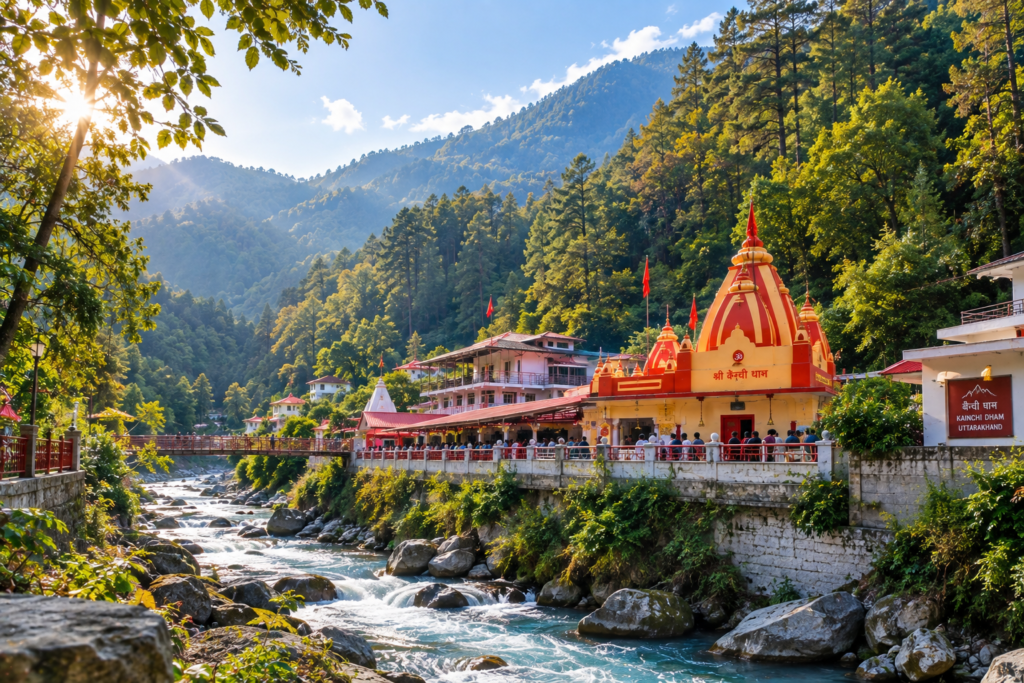
The name comes from the Hindi word for scissors, after the two hairpin bends in the road. The ashram sits at about 1,400 metres beside a small tributary of the Kosi River. It is a cluster of three main temples, offices and simple living quarters, with morning and evening prayers and communal meals.
Why Kainchi Dham Matters
It is a working pilgrimage. Every 15 June the ashram marks its foundation day with the Kainchi Dham Mela and a large communal feast. Crowds have grown fast. A June 2025 report said footfall had tripled in a year and that the chief minister ordered a crowd-control plan.
It feeds everyone. Meals are offered free to all visitors regardless of background. The ashram works as a kitchen and shelter first and a tourist site second, which is a big part of why visitors describe it as calm even when crowded.
It connects Indian bhakti to the wider world. Few Himalayan temples have such a long list of overseas seekers, and the section on famous visitors covers who came and what is actually documented.
The Ashrams of Neeb Karori Baba
| Ashram | Location | What to know |
|---|---|---|
| Kainchi Dham | Nainital district, Uttarakhand | The main ashram. Hanuman temple inaugurated 15 June 1964. |
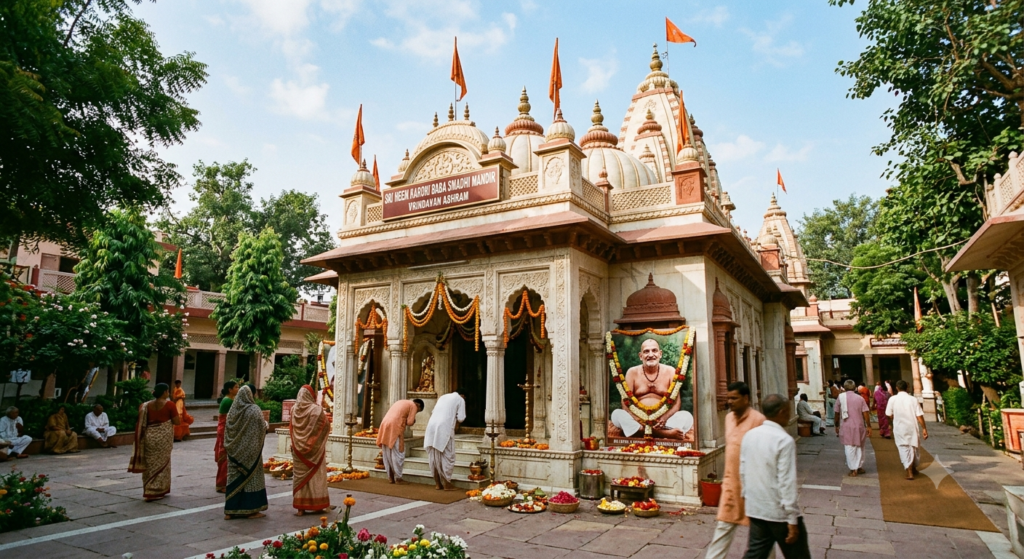
| Vrindavan | Uttar Pradesh | His samadhi shrine is inside the ashram complex. |
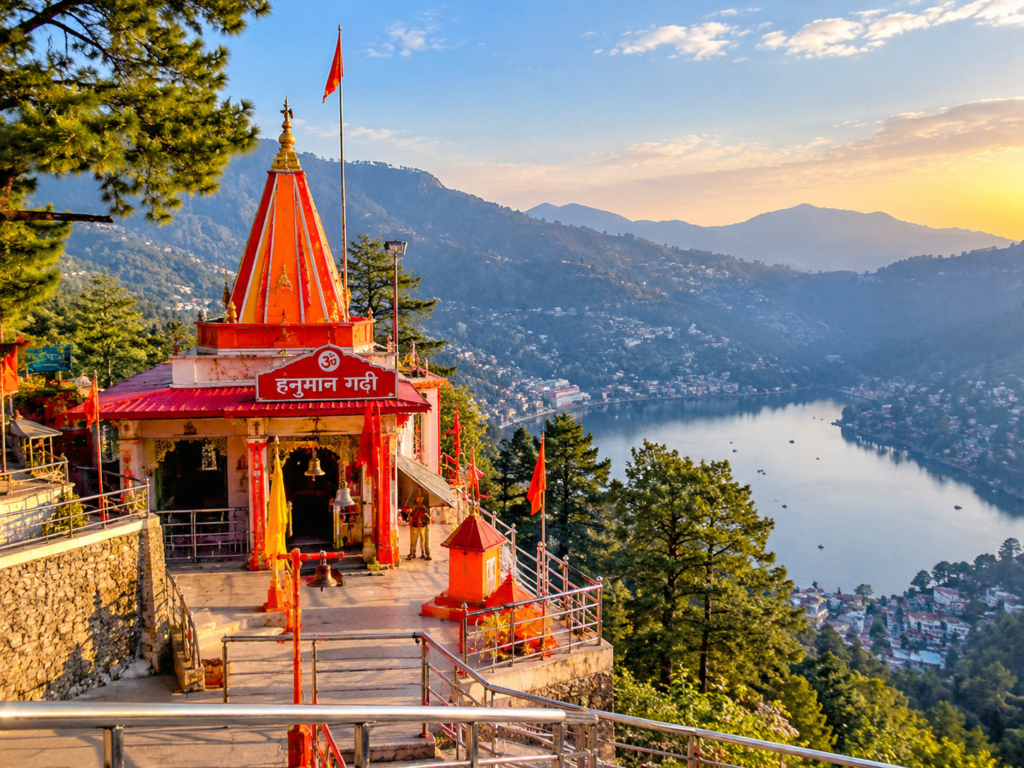
| Hanuman Garhi | Above Nainital | He first visited in 1950 when locals avoided the site. A small hut and Hanuman idol came first, a large statue in 1953 and a Shiva temple in 1957. |
| Kakrighat | Nainital–Almora road, about 30 minutes from Kainchi | Associated with Sombari Baba, and a place where Swami Vivekananda is said to have meditated in 1890. |
| Bhumiadhar | Kumaon hills | A roadside house and land were offered to Baba on 11 December 1961, and he installed a Hanuman murti. |
| Lucknow | Uttar Pradesh | Hanuman temple ashram inaugurated 26 January 1967. |
| Panki, Kanpur | Uttar Pradesh | Hanuman temple with a marble murti, begun by Baba in 1961. |
| Taos | New Mexico, USA | Founded later by American devotees. Daily aarti at 7 am and 7 pm. |
Ashrams linked to him also exist in Delhi, Rishikesh and the village of Neeb Karori.

The Famous People Connected to Him
Some of these stories are documented and some are devotional accounts, so each is labelled below.
Ram Dass
Richard Alpert, a Harvard psychologist known for psychedelic research, went to India in 1967. In Nepal he met the American sadhu Bhagavan Das, who took him to Baba. Baba became his guru and gave him the name Ram Dass, meaning “servant of God.”
In Be Here Now (1971), Ram Dass writes that Baba knew he had been thinking of his mother the night before and knew she had died of a spleen ailment. The book has sold over two million copies. He later co-founded the Seva Foundation with Larry Brilliant.
His famous LSD anecdote, in which Baba swallowed large doses with no effect, is a devotee account. Writers such as Terence McKenna and John Horgan doubted it, and Ram Dass stood by it.
Dr. Larry Brilliant
Brilliant, an American physician, reached Kainchi in the early 1970s and stayed. Baba called him “Dr. America.” He recalls that in July 1973 Baba told him to go to Delhi and work with the United Nations to help eradicate smallpox. He had no public health background and was turned away repeatedly before he joined the WHO programme. The WHO certified global eradication in 1980.
Brilliant credits the achievement to some 150,000 health workers, especially the local Indian staff, and asks not to be put on a pedestal.
Krishna Das, Jai Uttal, Bhagavan Das and Surya Das
All four are counted among his devotees. The 2012 documentary One Track Heart follows Krishna Das’s journey to India in search of Baba. Much of the Western kirtan scene traces back to this circle.
Steve Jobs
Jobs travelled to India in 1974 with his friend Daniel Kottke, reportedly hoping to meet Baba. Sources agree he arrived after Baba’s death. The trip is widely linked to his later ideas about simplicity and intuition. It is accurate to say Kainchi was part of his search, but not that Baba advised him.
Mark Zuckerberg
At a 2015 town hall with Prime Minister Narendra Modi, Zuckerberg said Jobs had told him to visit a temple in India to reconnect with his company’s mission, and that he spent almost a month travelling. The Kainchi visit is dated to 2008. He did not name the temple in that statement, though it is widely identified as Kainchi Dham.
Julia Roberts
She never met Baba. In a 2010 interview promoting Eat Pray Love, she said her interest in Hinduism came from seeing a photograph of a guru called Neem Karoli Baba.
Virat Kohli and Anushka Sharma
The couple visited Kainchi Dham on 17 November 2022 with their daughter Vamika, and later visited Vrindavan. Their visit brought fresh attention to the ashram.
His Last Days
In September 1973 Baba was on a night train back to Kainchi from Agra, where he had seen a heart specialist for chest pains. At Mathura station he began convulsing and was taken to a hospital. He died at about 1:15 a.m. on 11 September 1973 after slipping into a diabetic coma. His last words, repeated several times, were “Jaya Jagadish Hare.” His samadhi stands in the Vrindavan ashram complex.
Devotees say he never left, and that when they call, he answers. That is a matter of faith. What is on record is that the ashrams, temples and community he left are still active more than fifty years later.

Planning a Visit to Kainchi Dham
- By train: The nearest station is Kathgodam, roughly 35 to 40 km away, about 1.5 to 2 hours by road. The Ranikhet Express runs from Delhi to Kathgodam. Taxis are the practical way onward.
- By road: Delhi is around 350 km, 8 to 9 hours. Nainital is 17 km away.
- By air: Pantnagar airport is about 70 km away.
- Timing: Weekday mornings are quietest. Weekends and holidays draw crowds. Avoid 15 June unless you want the festival, since traffic on the Bhowali stretch can add hours.
- Etiquette: Dress modestly, remove footwear before the temple area, keep voices low, and follow the posted rules on photography, which is restricted inside.
- Staying: Don’t plan on an overnight stay. There is no online booking, and requests are handled in person at the ashram office. Stay in Bhowali or Nainital and visit for the day.
- Season: March to June and September to November are the most comfortable. Carry a light woollen layer even in summer.
Whatever brings you here, the invitation at Kainchi Dham has not changed since Baba’s time: sit down, eat what is served, and be kind to the person next to you.