


More than five hundred years ago, a wave of devotional awakening (भक्ति आंदोलन — Bhakti Andolan) swept through Bengal and eastern India, carried forward by a brilliant young scholar-turned-saint whose ecstatic singing, dancing, and chanting of God’s names drew enormous crowds wherever he traveled. That figure was Chaitanya Mahaprabhu (चैतन्य महाप्रभु), the founder of Gaudiya Vaishnavism (गौड़ीय वैष्णव संप्रदाय) and one of the most transformative saints in the history of Indian Bhakti. Revered by his followers as Gauranga (गौरांग) — a golden-complexioned incarnation of Lord Krishna himself — Chaitanya Mahaprabhu popularized congregational chanting of the Hare Krishna Mahamantra (हरे कृष्ण महामंत्र), a practice that continues to shape devotional life worldwide today through movements such as ISKCON.
हरे कृष्ण हरे कृष्ण
कृष्ण कृष्ण हरे हरे
हरे राम हरे राम
राम राम हरे हरे
This detailed article explores his birth, childhood, family life, guru-diksha (गुरु-दीक्षा), renunciation, philosophy, disciples, writings, and the vast legacy he left behind — one that still echoes in kirtans (कीर्तन) sung across the world.
Early Life and Birth of Chaitanya Mahaprabhu
Birth in Mayapur
Chaitanya Mahaprabhu was born in 1486 CE, on the full moon night of the month of Phalguna, in Mayapur, a town within the Nadia (नदिया) district of Bengal, near the sacred river Bhagirathi (भागीरथी), a branch of the Ganga. His father, Jagannath Mishra (जगन्नाथ मिश्र), was a respected Brahmin scholar and teacher, while his mother, Sachi Devi (शचि देवी), is remembered in tradition for giving birth to him beneath a neem tree — an event that led the family and villagers to affectionately call the newborn “Nimai” (निमाई).
The night of his birth coincided with a lunar eclipse, during which, according to custom, the people of Nadia had gathered along the riverbanks to bathe and chant the holy names of God. This coincidence of collective chanting at the very hour of his birth is remembered by devotees as deeply symbolic of the mission he would later undertake — spreading Nama-Sankirtan (नाम-संकीर्तन), the congregational chanting of God’s names, across India.
Because of his strikingly radiant, golden-hued complexion — in contrast to the traditionally blue-black complexion associated with Lord Krishna — he also came to be known by the name Gauranga (गौरांग), meaning “one with a golden body.”
Family Background
Chaitanya was not Sachi Devi’s first child; several of her earlier children had died in infancy, which is said to have made the family especially protective and devoted toward Nimai. He had one surviving elder brother, Vishvarupa (विश्वरूप), who himself renounced worldly life and took sannyasa at a young age — a decision that deeply affected the family and, according to tradition, weighed on young Nimai’s mind for years afterward.
Childhood and Scholarly Brilliance
The Making of “Nimai Pandit”
From an early age, Nimai displayed an extraordinary intellect. He mastered Sanskrit vyakaran (व्याकरण, grammar), Nyaya (न्याय, logic), and Smriti (स्मृति, traditional law and scripture) with remarkable speed, and by his teenage years, he was already running his own small school (tol) in Nadia, teaching students who were sometimes older than himself.
He became locally famous for his ability to defeat seasoned scholars in shastrartha (शास्त्रार्थ, scriptural debate), a skill that earned him the honorific title “Nimai Pandit.” Contemporary accounts describe him as strikingly handsome, energetic, and somewhat proud of his scholarship during this period of his life — a personality that would undergo a dramatic transformation in the years that followed.
Family Life, Marriage, and the Path Toward Renunciation
First Marriage — Lakshmidevi
At around the age of 14 or 15, Chaitanya married Lakshmidevi (लक्ष्मीदेवी), the daughter of the scholar Vallabhacharya. Soon after, his father Jagannath Mishra passed away, leaving Sachi Devi a widow. To support the family, Chaitanya traveled to East Bengal to teach and earn a livelihood, continuing his preaching of Vaishnav principles along the way.
While he was away, Lakshmidevi died from a snakebite — a tragedy that deeply affected the young scholar and is often described by biographers as a quiet turning point that began softening his heart toward renunciation and devotion.
Second Marriage — Vishnupriya
On his return, Chaitanya found his mother grieving deeply, both for her daughter-in-law and for the earlier loss of her husband. To console her, he is said to have spoken to her about the impermanence of the material world (संसार की नश्वरता) — a theme that would later become central to his teaching. At Sachi Devi’s request, he married a second time, to Vishnupriya (विष्णुप्रिया), the daughter of the Pandit Sanatana Mishra, and continued to live as a householder for a time while balancing his growing scholarly reputation.
During this period, a renowned Kashmiri Pandit named Keshava Mishra traveled to Nadia specifically to challenge Nimai in debate. According to tradition, the contest was brief — Nimai’s command of logic and scripture was so overwhelming that Keshava Mishra left the town in humiliation, further cementing Nimai’s reputation as an unrivaled young scholar.
Guru-Diksha: Initiation and Spiritual Awakening
Meeting Ishvara Puri in Gaya
At the age of 16 (some accounts say slightly older), Nimai traveled to Gaya, a sacred pilgrimage town in Bihar, ostensibly to perform funeral rites for his father. There, he met Ishvara Puri (ईश्वर पुरी), a Vaishnava sannyasi in the spiritual lineage of Madhavendra Puri, and received diksha (दीक्षा, spiritual initiation) from him, along with the Krishna mantra.
This meeting proved to be the defining spiritual moment of his life. Those who saw him after his return to Nadia described a man utterly transformed — moved to tears, trembling, and falling into deep states of spiritual absorption simply upon hearing the name of Krishna spoken aloud.
The Birth of the Kirtan Movement in Nadia

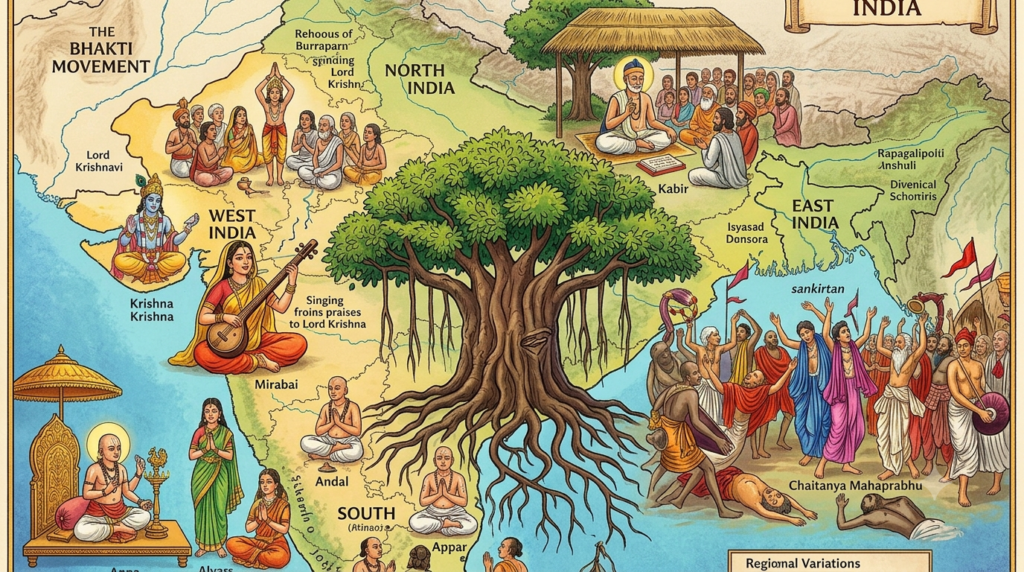
On returning home, Nimai abandoned his former life of scholarly debate almost entirely and began holding nightly gatherings of kirtan (कीर्तन, devotional singing) at the home of a devoted follower, Shrivasa Pandit (श्रीवास पंडित). Alongside close associates — Nityananda Prabhu (नित्यानंद प्रभु), Advaita Acharya (अद्वैत आचार्य), and Gadadhara Pandit (गदाधर पंडित) — he would sing, weep, and dance in states of ecstatic devotion, chanting the names of Krishna long into the night.
Together, Chaitanya, Nityananda, Advaita, Gadadhara, and Shrivasa are collectively revered by Gaudiya Vaishnavas as the Panch Tattva (पंच तत्त्व) — the five essential features of the divine that together carry out the mission of spreading devotion in the world.
As word of these gatherings spread, Nadia became a thriving center of Vaishnava devotion, drawing seekers from across the region. However, not everyone approved — some critics dismissed the emotional singing and dancing as mere sentimentalism unbecoming of a respected scholar, and local orthodox authorities reportedly grew uneasy at the growing crowds.
Taking Sannyasa
Sensing that his householder status was becoming an obstacle to the wider mission he felt called to, Chaitanya made the momentous decision, at the age of 24, to renounce worldly life and take formal sannyasa (सन्यास). He shaved his head, wore the saffron robes of a renunciate, took up the tridanda (त्रिदंड), the traditional staff of a Vaishnava monk, and left his home — a departure that left his mother Sachi Devi and his wife Vishnupriya in deep sorrow.
Travels Across India: Spreading the Sankirtan Movement
After renunciation, Chaitanya Mahaprabhu spent the rest of his life traveling and teaching, spreading what came to be known as the Sankirtan movement (संकीर्तन आंदोलन) — the practice of chanting God’s names loudly and collectively, in public, regardless of a person’s caste or social standing.
Jagannath Puri
Chaitanya made Jagannath Puri (जगन्नाथ पुरी) in Odisha his primary base for most of his remaining years. He became deeply associated with the worship of Lord Jagannath, and took part in the famous Rath Yatra (रथ यात्रा) festivities, where devotees describe him dancing before the deity’s chariot in states of overwhelming spiritual emotion. His presence is said to have transformed Puri into a major center of Vaishnava devotion, drawing devotees from across the subcontinent.
South India
Chaitanya undertook an extensive tour of South India, traveling largely alone for months, visiting temple towns, engaging local scholars and devotees, and spreading the practice of Nama-Sankirtan. Traditional accounts describe his journey as touching the hearts of common people and scholars alike, spreading the message that devotion to Krishna was open to everyone.
Vrindavan
Chaitanya’s visit to Vrindavan (वृन्दावन) — the land associated with Krishna’s childhood pastimes — is considered one of the most significant chapters of his life. At the time, many of Krishna’s legendary pastime sites had fallen into obscurity. Chaitanya’s visit, and the mission he later entrusted to his disciples, played a central role in reviving Vrindavan as one of the most important pilgrimage destinations in the Vaishnava tradition.
Prayag and Varanasi
In Prayag (प्रयाग, Allahabad), Chaitanya spent considerable time with Rupa Goswami, imparting deep philosophical instruction over the course of about ten days — a teaching later recorded in detail by his biographers. In Varanasi (काशी), he engaged directly with followers of the Advaita (अद्वैत) philosophy of Adi Shankaracharya, which emphasizes the impersonal, formless nature of the ultimate reality. Chaitanya argued instead for personalism — that God possesses form, qualities, and personality, and can be approached through loving devotion rather than abstract impersonal realization alone.
Key Disciples and the Six Goswamis of Vrindavan
Among Chaitanya’s most important contributions was the training of a group of highly learned disciples who would go on to systematize his teachings into a coherent philosophical and literary tradition. Chief among them were the brothers Rupa Goswami (रूप गोस्वामी) and Sanatana Goswami (सनातन गोस्वामी), both of whom had previously held high administrative positions before renouncing worldly careers to follow Chaitanya.
Along with four other scholar-saints, they are collectively remembered as the Six Goswamis of Vrindavan (वृन्दावन के छह गोस्वामी), credited with composing foundational Gaudiya Vaishnava texts on theology, devotional practice (भक्ति साधना), and the aesthetics of divine love — work that gave lasting philosophical structure to Chaitanya’s ecstatic teachings.
Core Teachings and Philosophy
Achintya Bheda Abheda Tattva
The philosophical core of Chaitanya Mahaprabhu’s teaching is known as Achintya Bheda Abheda Tattva (अचिन्त्य भेदाभेद तत्त्व) — the doctrine of “inconceivable, simultaneous oneness and difference” between the individual soul (jivatma, जीवात्मा) and the Supreme Being (Paramatma, परमात्मा).
Rather than teaching that the soul ultimately dissolves into an impersonal absolute — as some earlier monist schools held — Chaitanya taught that the soul remains eternally, individually distinct from God, while simultaneously sharing a deep spiritual oneness of quality with the divine. This philosophical position preserves the possibility of eternal, personal, loving devotion (bhakti) between the soul and God, rather than a final merging that would dissolve individuality altogether.
Bhakti as the Path for the Age
Chaitanya taught that in the current age — described in Hindu cosmology as Kali Yuga (कलियुग) — the most direct, accessible path to spiritual realization is not elaborate ritual, severe austerity, or even scholarly study alone, but bhakti (भक्ति): heartfelt devotional love, expressed above all through the chanting of God’s holy names.
The Hare Krishna Mahamantra
Central to his entire mission was the sixteen-word mantra:
हरे कृष्ण हरे कृष्ण
कृष्ण कृष्ण हरे हरे
हरे राम हरे राम
राम राम हरे हरे
Chaitanya taught that chanting this mahamantra — ideally in sankirtan, that is, collectively, out loud, often with singing and dancing — had the power to purify the heart and awaken dormant love for the divine. Crucially, he taught that this practice was open to everyone: Brahmins and non-Brahmins, scholars and the unlettered, men and women alike — a genuinely inclusive spiritual vision that stood apart from the rigid social restrictions of much contemporary religious practice.
Equality Among Devotees
One of the more socially significant aspects of Chaitanya’s mission was his acceptance of disciples across caste lines. Figures such as Haridasa Thakura (हरिदास ठाकुर) — born into a Muslim family and often called the “Namacharya,” or teacher of the holy name — became one of his most celebrated associates, illustrating Chaitanya’s conviction that sincere devotion mattered more than birth or social status.
The Siksastakam: Chaitanya’s Only Written Work
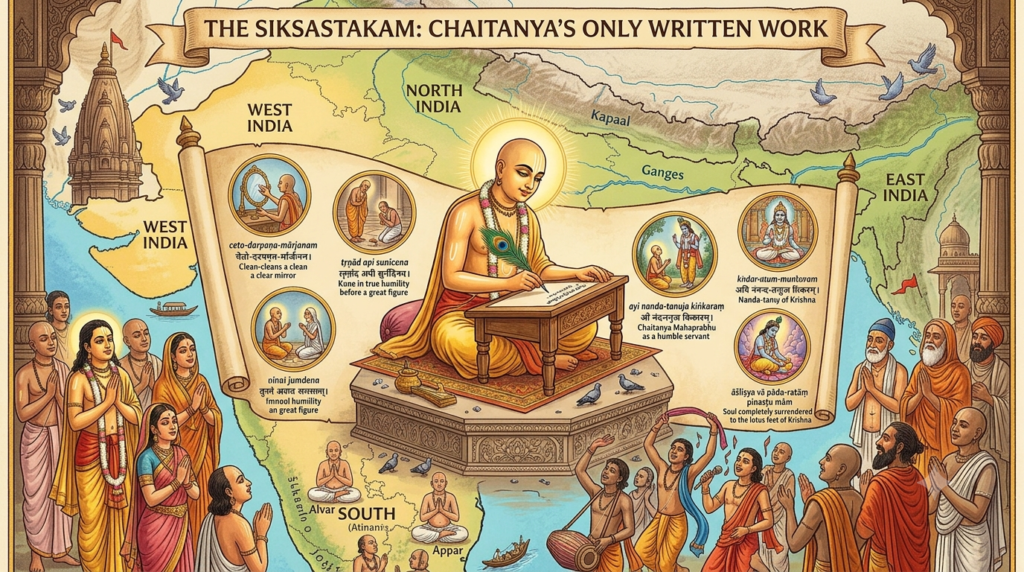
Although Chaitanya Mahaprabhu inspired an enormous body of devotional literature through his disciples, he himself is traditionally credited with composing only eight verses in Sanskrit, known as the Siksastakam (शिक्षाष्टकम्) — “eight instructions.” These verses, still recited and studied by Gaudiya Vaishnavas today, express the glories of chanting the holy name, the humility required of a true devotee, and intense longing for divine love. It remains the most direct literary window into his own spiritual heart.
Biographies Written by His Disciples
While Chaitanya himself wrote little, his life and teachings were extensively documented by devoted followers in the generations after him. The two most important biographical works are:
- Chaitanya Bhagavata (चैतन्य भागवत), composed by Vrindavan Das Thakura, focusing heavily on Chaitanya’s early life in Nadia.
- Chaitanya Charitamrita (चैतन्य चरितामृत), composed by Krishnadasa Kaviraja, widely regarded as the most comprehensive and theologically rich biography, covering his later life, travels, and philosophical teachings in great depth.
These texts remain the primary scriptural sources through which Gaudiya Vaishnavas understand his life and mission today.
Scriptural References Cited by Followers
Gaudiya Vaishnavas point to several classical scriptures that they believe foretell Chaitanya’s appearance as an incarnation of Krishna:
- A verse from the Srimad Bhagavatam (श्रीमद्भागवतम्) describes a coming incarnation, not dark in complexion, who would be worshipped through congregational chanting in the age of Kali — a description devotees closely associate with Chaitanya’s golden form.
- The Garuda Purana (गरुड़ पुराण) is cited by tradition as containing a prophecy of a divine appearance in Nabadwip as the son of a mother named Sachi.
- Descriptions in the Vishnu Sahasranama (विष्णु सहस्रनाम) tradition of a golden-complexioned form adorned with sandalwood are similarly interpreted by devotees as pointing to Chaitanya’s appearance.
The Final Years and Disappearance
Chaitanya spent his final eighteen years largely in Jagannath Puri, continuing to guide disciples, correspond with the Goswamis in Vrindavan, and immerse himself in deep states of spiritual absorption that biographers describe as increasingly intense in his later years. He passed from this world around 1534 CE, at the age of 48. The exact circumstances of his disappearance remain a matter of devotional mystery and reverence rather than settled historical record, and are described with deep symbolic significance in traditional Gaudiya biographies.
Legacy and Global Influence
Growth of Gaudiya Vaishnavism
In the centuries following Chaitanya’s disappearance, Gaudiya Vaishnavism flourished across Bengal and Odisha, sustained by the theological writings of the Six Goswamis and a continuous line of teachers (acharyas, आचार्य) and devotional communities.
The Global Hare Krishna Movement
The tradition reached a truly global audience in the twentieth century through A. C. Bhaktivedanta Swami Prabhupada, who traveled to the United States in 1965 and founded the International Society for Krishna Consciousness (ISKCON) in 1966. Today, ISKCON temples and Gaudiya Vaishnava communities exist on every continent, and the chanting of Hare Krishna Hare Krishna, Krishna Krishna Hare Hare, Hare Rama Hare Rama, Rama Rama Hare Hare — the very mantra Chaitanya Mahaprabhu popularized five centuries ago in the streets of Nadia — is now heard in cities across the world.
Cultural Influence in Bengal and Odisha
Beyond formal religious practice, Chaitanya Mahaprabhu’s life and teachings have deeply shaped Bengali and Odia devotional music, literature, and art, inspiring centuries of padavali kirtan (पदावली कीर्तन) poetry, temple architecture, and festival traditions that continue to this day, particularly around Nabadwip and Puri.
Conclusion
Chaitanya Mahaprabhu’s journey — from a brilliant, self-assured young logician in Nadia to a wandering saint whose ecstatic chanting reshaped devotional life across India — remains one of the most remarkable transformations in Indian spiritual history. His teaching that sincere love for the divine, expressed through simple, joyful, congregational chanting, was available to every human being regardless of caste, scholarship, or status, gave the Bhakti movement one of its most powerful and enduring expressions. Five hundred years later, the mahamantra he sang through the streets of Bengal continues to resonate in temples, homes, and public gatherings around the globe.
हरे कृष्ण हरे कृष्ण, कृष्ण कृष्ण हरे हरे
हरे राम हरे राम, राम राम हरे हरे
Also Read About: